
Both conventional and addressable fire alarm systems do the same core job — detect smoke or heat and raise an alarm. They differ in how much detail the control panel gives your team when it does.
Conventional systems: zone-level detection
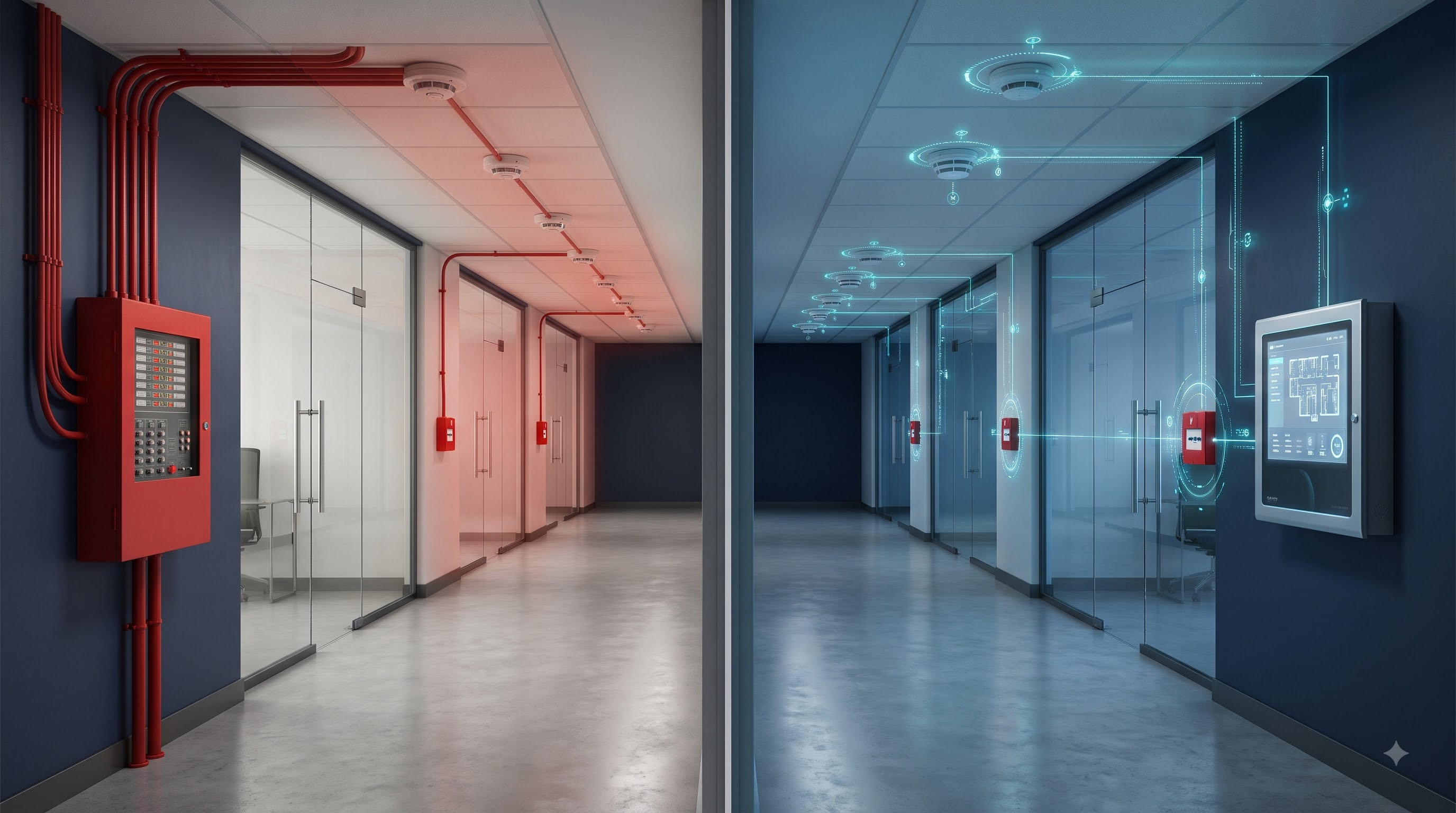
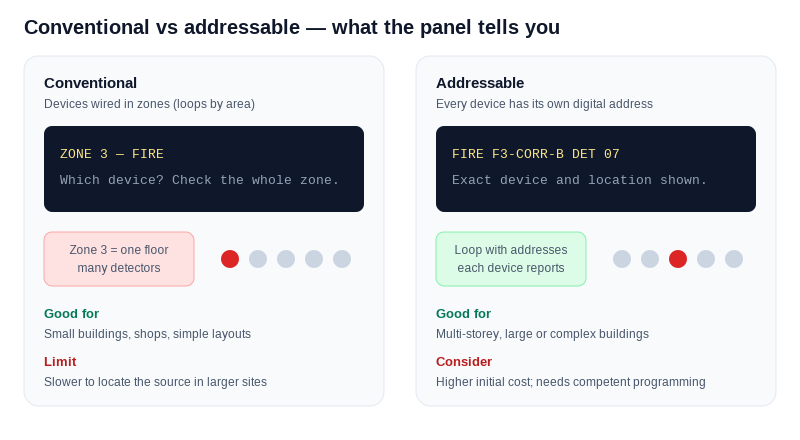
Conventional panels divide the building into wired zones — typically by floor or area. When any detector in a zone triggers, the panel shows which zone is in alarm, but not which exact detector. Someone still has to walk the zone to find the source. This works well for smaller buildings, shops and simple single-floor layouts where "zone 3" already tells the team roughly where to look.
Addressable systems: device-level detection
Addressable panels assign a unique digital address to every detector, call point and sounder on the loop. When one triggers, the panel displays the exact device — for example "Floor 3, Corridor B, Detector 07" — cutting the time it takes to locate and confirm the fire. This precision is why addressable systems are standard in multi-storey, large-footprint or high-occupancy buildings.
Side-by-side comparison
| Conventional | Addressable | |
|---|---|---|
| Fault/fire location | Zone-level only | Exact device |
| Wiring | Parallel zone circuits | Loop wiring, fewer cable runs on large sites |
| Best suited to | Small / simple buildings | High-rise, large or complex buildings |
| Upfront cost | Generally lower | Generally higher, offset by easier diagnostics |
| Expansion | Limited by zone wiring | Devices added along the loop more flexibly |
What actually decides which you need
Building height, floor area, occupancy type and the applicable fire code — not personal preference — determine the system class required. A fire safety assessment confirms what your specific building needs and whether an existing conventional system still meets current requirements.
Frequently asked questions
Can a conventional system be upgraded to addressable later?
Usually not as a simple add-on. Addressable systems use different detectors, wiring topology (a loop rather than parallel zone wiring) and a different panel, so an upgrade is normally a planned replacement rather than a retrofit of individual parts.
Which system is required by law in Maharashtra?
The applicable building and fire code, building height, occupancy and the approved fire plan determine what is required for a specific building — not a blanket rule. Confirm the requirement for your building with a licensed fire agency or the Directorate of Maharashtra Fire & Emergency Services.
Choosing a panel for a new or upgraded system?
Samarth Fire installs, troubleshoots and maintains both conventional and addressable fire alarm systems across Mumbai.
This article is general information. It is not legal advice, an emergency-response instruction, a substitute for approved site drawings or a fire-safety certificate. Requirements depend on the building, its occupancy and the current rules of the competent authority — always confirm with the Directorate of Maharashtra Fire & Emergency Services or a licensed agency.