
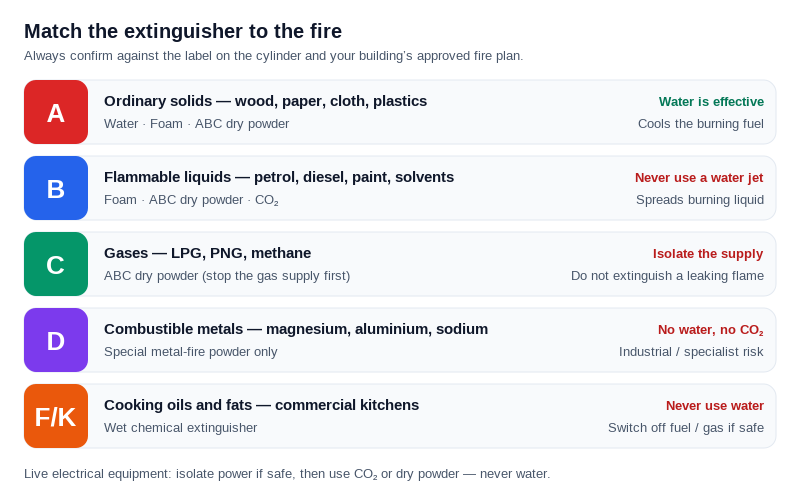
Fire extinguishers are not interchangeable. Each type is designed, pressurised and labelled for specific fuel types — using the wrong one on a liquid fire or live electrical equipment can spread the fire or create a shock hazard. Knowing the five fire classes used in India is the fastest way to choose correctly.
The five fire classes
| Class | Typical fuel | Suitable extinguisher |
|---|---|---|
| A | Wood, paper, cloth, most plastics | Water, foam, or ABC dry powder |
| B | Petrol, diesel, paint, solvents, oil | Foam, ABC dry powder, or CO₂ |
| C | Flammable gases — LPG, PNG, methane | ABC dry powder, after isolating the gas supply |
| D | Combustible metals — magnesium, aluminium swarf, sodium | Specialist metal-fire powder only |
| F / K | Cooking oils and fats | Wet chemical extinguisher |
Most Indian homes, offices and common areas are protected mainly against Class A, B and electrical risk, which is why the general-purpose ABC dry powder and CO₂ extinguishers are so common. Class D and specialised Class F/K risks are usually confined to specific areas — a workshop, a commercial kitchen — and are addressed separately in the fire plan.
Water and foam extinguishers
Water extinguishers cool burning solids (Class A) effectively but must never be used on burning liquids, live electrical equipment or cooking oil — the stream can spread a liquid fire or create a severe shock risk. Foam extinguishers add a smothering layer on top of flammable liquids and also work on Class A fires, which is why foam is common in car parks, generator rooms and fuel-storage areas.
CO₂ extinguishers
CO₂ (carbon dioxide) extinguishers displace oxygen and leave no residue, which makes them the preferred choice around electrical panels, server rooms, control rooms and sensitive equipment. They are less effective outdoors or in draughty areas, and the discharge horn gets extremely cold — hold it by the handle, not the horn.
ABC dry powder extinguishers
ABC dry powder is the most common general-purpose extinguisher in Indian buildings because it covers solids, liquids and (with the gas supply isolated) gas fires in one cylinder. The trade-off is residue: the fine powder is corrosive to electronics and leaves a mess that needs cleaning, so many sites still prefer CO₂ specifically near computers and panels.
Wet chemical extinguishers (kitchens)
Commercial kitchens with deep-fat fryers need a wet chemical extinguisher. It applies a fine mist that cools the oil and forms a soap-like layer (saponification) that seals the surface and prevents re-ignition — something water, foam, CO₂ and dry powder cannot safely do on hot oil.
Common mistakes that make an extinguisher useless
- Wrong type for the fuel — e.g. water on an electrical or oil fire.
- Expired or unpressurised cylinder — the gauge needle should sit in the green zone.
- Blocked access — extinguishers stacked behind furniture or stock.
- Seized pin or seal — never tested, so it fails exactly when needed.
- No one trained in the P.A.S.S. technique (Pull, Aim, Squeeze, Sweep).
Frequently asked questions
Can I use a CO2 extinguisher on a cooking oil fire?
No. Cooking oil and fat fires (Class F/K) need a wet chemical extinguisher. CO2 and dry powder can disturb hot oil and are not designed to cool or seal it, so they are not suitable for deep-fat fryer fires.
Is one ABC dry powder extinguisher enough for a whole flat or office?
The right number, size and placement of extinguishers depends on floor area, occupancy and travel distance under the applicable building and fire code, not a fixed rule of thumb. A site assessment by a licensed agency gives a specific recommendation.
Not sure what your building needs?
Samarth Fire supplies, refills and hydro-tests ISI-marked extinguishers, and can map the right type and count to your floor plan during a site visit.
This article is general information. It is not legal advice, an emergency-response instruction, a substitute for approved site drawings or a fire-safety certificate. Requirements depend on the building, its occupancy and the current rules of the competent authority — always confirm with the Directorate of Maharashtra Fire & Emergency Services or a licensed agency.